Broadcast on the BBC Today Programme, 24th January 2013: “Music and singing should be central to education and children’s lives” …
We all want our little guys to fly …!
Music and singing are excellent for introducing sounds in other languages.
A Green Mouse is creating and sharing free French and Spanish listening practice for any child:
Songs for young children, and many video resources to link sound to words in accessible visual contexts for early listening and speaking practice.
Winter Weather in French verbs, vocabulary + practice for children – Videos, worksheet + online quiz.
Subtitled Video clips illustrate and describe winter scenes and activities in French in the Present Tense.
French Weather Vocabulary
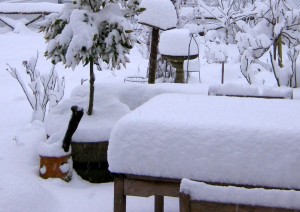
C’est l’hiver! It’s winter! Il fait froid! It’s cold! Il gèle It’s freezing!
J’ai froid = I am cold.
Tu aimes la neige? = Do you like snow? Oui, J’aime la neige. = Yes, I like snow Non, Je n’aime pas la neige. = No, I don’t like snow.
Il y a beaucoup de neige = There is lots of snow.
un bonhomme de neige = a snowman un manteau = a coat
Verbs
s’attacher = to stick to s’amuser = to have fun rentrer = to go home faire = to do
il veut = he wants Il veut faire du ski = He wants to ski.
il faut = one/you/we must/should Il faut rentrer à la maison.
= One/you/we must go home.
Examples of Avoir
Tu as un problème = You have a problem. Ce petit chien a un manteau.
= This little dog has a coat.
Les oiseaux ont faim. = The birds are hungry.
Il y a beaucoup de neige! There is a lot of snow!
Examples of Être
C’est = it is Billy est fier = Billy is proud. (What of?) Ils sont très contents. = They are very happy.
Monter and Descendre belong to the group of irregular French Verbs which are conjugated with Être in the Passé Composé (Perfect Tense).
However, when there is a DIRECT OBJECT in the sentence, they must be conjugated with Avoir instead of Être.
A Direct Object is what or who the verb does something to.
Eg: J’ai monté l’escalier – I went up the stairs
(l’escalier is the direct object)
Look at this sentence: “Je suis monté pour voir le match.”
(I went up to see the match)
Is there a direct object?
NO – There is nothing in the sentence that the verb does something to. Therefore monter is used with être.
Sortir, Rentrer, Entrer and Passer also belong to the irregular group of ‘Être’ verbs that change to using Avoir if they have a direct object:
E.g. Je suis sorti = I went out. J’ai sorti la poubelle = I took out the bin.
(La poubelle is the direct object)
Le Match
J’ai monté l’escalier roulant.
Je suis monté pour voir le match. Le Jambon:
J’ai sorti le jambon.
Le chien est entré.
Il a vu le jambon. Il a vu l’escabeau.
Il est monté.
Il a monté l’escabeau. Le Renard:
Le voilà.
Le chien a vu son renard.
Il est monté.
Il a monté l’escalier.
Il a pris son jouet. Il est descendu.
Il a descendu l’escalier.
Il a descendu son renard! Pauvre Maggie:
J’ai monté Maggie sur le comptoir.
Elle est descendue tout de suite! Les Marches:
Maggie est montée.
Les deux chiens sont montés.
Ils ont monté les marches.
Ils sont arrivés en haut.
Ils sont descendus.
Ils ont descendu les marches. Le Pot:
J’ai sorti un pot.
J’ai descendu le pot.
Esto es una piñata.
Adentro hay caramelos.
Aquí hay otra.
Hay que pegar la piñata para sacar los caramelos.
¿Quieren hacer una?
Primero hay que inflar un globo.
Hay que preparar la cola.
Hay que mezclar agua con harina.
Tiene que ser bastante líquido.
Hay que cortar pedazos largos de papel.
Hay que cubrir el globo con el papel.
Hay que pegar cada pedazo de papel con la cola.
Poquito a poquito hay que cubrir todo el globo y poner más cola.
Hay que dejar el globo en un lugar seco durante tres días.
Mientras tanto hay que comprar caramelos.
Ya está. El modelo está seco.
Hay que cortar el globo y sacarlo.
Ahora hay que cubrir el modelo con cosas lindas y meter los caramelos.
Una piñata para un niño …
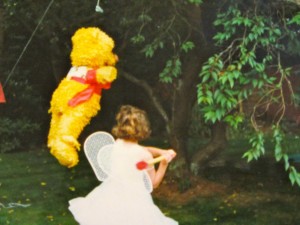
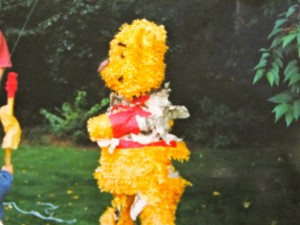
No Central American birthday party would be complete without a piñata. Sometimes they are a work of art, like this wonderful Winnie the Pooh from Tegucigalpa, Honduras, almost too beautiful to destroy! Before:
Just before total destruction:
Simple Piñata Instructions
Blow up a balloon.
Mix flour and water to make a glue with a runny consistency. (This is quick and easy, and more can be made if you run out)
Tear long strips of newspaper.
Use a brush to paste the glue onto the strips, putting them onto the balloon, one at time, and pasting them again each time you add another strip.
Cover the balloon with about three layers of newspaper. Then do a final pasting with the glue.
Leave to dry – Takes about three days.
Pop the balloon and pull it out.
Fill the piñata with sweets
Decorate the piñata by painting it and covering it with streamers and pictures of choice.
Tie it with string and hang it in a safe place.
Make sure that the children stand well away from harm as each child in turn is blindfolded and handed the stick to have a go at bashing the piñata until the sweets fall out.
Hay Que
Click here for more practice using Hay que + infinitive go to: Hay que …
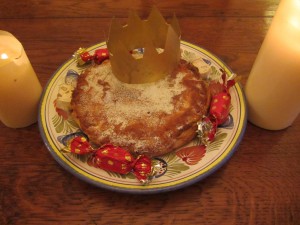
A Galette des Rois is a traditional French Three Kings’ Day cake prepared for 6th January, Epiphany.
This is an easy recipe + video clips for a Galette des Rois using bought pastry.
This cake is fun, delicious, and the video clips provide instructions + listening practice for anyone learning French.
There is a worksheet with instructions in French and English below the video clips.
French/English Christmas traditions:
A coin is often hidden in the Christmas pudding … In France a tiny figure called a ‘fève‘ or an almond is hidden in the galette des rois – Watch the video and see the fève nestled in the almond mixture.
Ingredients
1 packet de pâte feuilletée
1 packet of puff pastry
Vocabulary, Video Clips, Worksheet + Online Quiz to learn the names of Parts of the Body in Spanish. Practice in short phrases and sentences.
Vocabulary + Gender
El cuerpo(m) = the body
Un, Una = a Unos, Unas = some
1. Feminine Body parts: La cara the face La boca the mouth La nariz the nose La lengua the tongue La cabeza the head La espalda the head La oreja the ear
Las orejas(fpl) the ears La mano the hand
Las manos(fpl) the hands La rodilla the knee
Las rodillas(fpl) the knees La pierna the leg
Las piernas(fpl the legs La pestaña the eyelash
Las pestañas(fpl) the eyelashes La ceja the eyebrow
Las cejas(fpl) the eyebrows
2. Masculine Body parts: El vientre the stomach El estómago the stomach El pelo the hair El ojo the eye
Los ojos(mpl) the eyes El diente the tooth
Los dientes(mpl) the teeth El brazo the arm
Los brazos(mpl) the arms El codo the elbow
Los codos(mpl) the elbows El dedo the finger
Los dedos(mpl) the fingers El pie the foot
Los pies(mpl) the feet
¡Hola! Soy Billy. Esta es mi cara.
La cara.
Tengo dos ojos. Tengo dos orejas.
Tengo una nariz negra.
¡Hola! Soy una gansa.
Esta es mi cara. La cara.
Tengo una nariz naranja muy grande.
Llevo gafas. Las gafas.
Soy una muñeca. Esta es mi cara.
Tengo el pelo rojo.
Esta es mi boca.
Una boca – La boca. Los dientes son horribles.
Los dientes.
¡Uy! ¡Mira los dientes de Billy!
¡Mira su nariz!
¡Hola! Soy Maggie. ¡Esta es mi lengua!
La lengua.
¡Hola! Soy un oso.
Tengo un vientre grande y peludo.
El vientre o … el estómago.
Un brazo –
El brazo tiene un codo y una mano.
El codo.
La mano.
La mano tiene dedos –
El dedo – Los dedos. El hombre tiene dos brazos.
El brazo. Esto es una rodilla – La rodilla. El hombre tiene dos rodillas. Tiene dos pies también –
El pie Y una espalda muy fuerte –
Una espalda – La espalda
¡Hola! Soy un mono.
Esta es mi cara.
Mira mi oreja.
La oreja. Las orejas.
Tengo dos orejas.
Tengo dos brazos.
Y tengo dos piernas también.
Las piernas.
– – – –
A puppy = un chiot(m)
A new puppy = un nouveau chiot
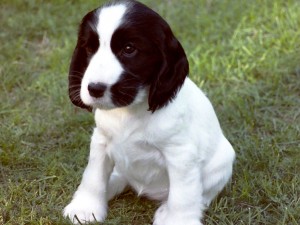
Meet Maggie, a seven week old puppy, and follow her as she settles in with her new family. Story, video clips, online quiz + worksheets for practice using French verbs in the 3rd person present tense, including aimer, être and avoir.
AIMER:
to like
Elle aime she likes
Ellen’aime pas
She does not like
ÊTRE:
to be
Elle est She is
Elle est belle
She is beautiful
Elle est dans le linge!
She is in the washing!
AVOIR:
to have Elle a She has
Elle a peur
She has fear = She is frightened. Elle apeur du jardin She is frightened of the garden.
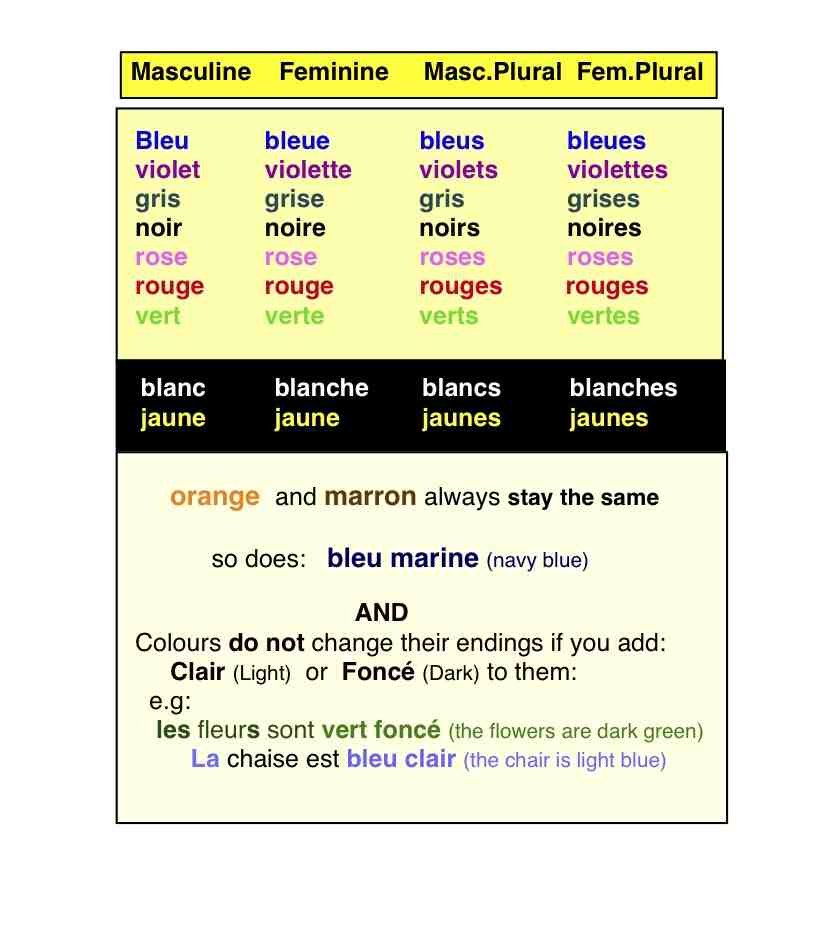
Colours are adjectives. In French they go after the word they describe. Eg:
‘The white dog’ becomes ‘the dog white’: Le chien blanc.
Most simple colours in French change their endings to agree with the word (noun) they describe.
E.g:
Le crayon vert = the green pencil
Les crayons verts = the green pencils La voiture verte = the green car
Les voitures vertes = the green cars
Invariable Colours
Some colours DO NOT change their endings in French.
They are called ‘invariable’. Orange + Marron(brown) + ALL Colour Combinations are invariable.
E.g. La voiture bleu marine
= the navy blue car Les camions bleu marine
= the navy blue trucks La voiture vert foncé
= the dark green car Le camion vert foncé
= the dark green truck Le camion orange
= the orange truck
‘de couleur‘ is often added to invariable colours.
E.g:
Les voitures(f) de couleur marron
= the brown cars
Study this table for more information on gender and singular and plural endings.
Follow and join in with the the video. Then do the Online Quiz + Worksheet.
Video
Online Quiz
This quiz is also available on its own separate page here: online quiz
Learn the present tense of the verb AVOIR.
AVOIR = TO HAVE
It also means TO BE in certain situations. – Use AVOIR with AGE and feelings of hunger, thirst, fear and need or desire to do things. Video clip, Online Quiz, + Worksheet.
J’ai I have tu as you have il/elle a he/she has nous avons we have vous avez you (plural) have Ils/elles ont they have
AVOIR = to have: J’ai un chat I have a cat Ils ont une voiture They have a car
AVOIR + Feelings
E.g. Having hunger … Avoir faim to have hunger = to be hungry J’ai faim I am hungry (I have hunger!)
– – – – Avoir soif to be thirsty J’ai soif I am thirsty (I have thirst!)
– – – – Avoir peur to be scared J’ai peur I am scared/frightened (I have fear!)
– – – – Avoir froid to be cold J’ai froid I am cold
– – – – Avoir chaud to be hot J’ai chaud I am hot
– – – – Avoir mal to be ill J’ai mal I am ill
– – – – Avoir raison to be right J’ai raison I am right
– – – – Avoir tort to be wrong J’ai tort I am wrong
– – – –
AVOIR + Age
Quel âge as-tu?
How old are you? J’ai douze ans
I am twelve (I have been around for 12 years ..?!)
– – – –
AVOIR to want or need something
Avoir besoin de – to need … J’ai besoin de quelque chose!
I NEED something!
Avoir envie de to want … J’ai envie de jouer!
I want to play!
– – –
Avoir de la chance To be lucky Tu as de la chance!
You are lucky!
– – – –
AVOIR to say ‘there is/there are’:
E.g: Oh! Il y a un crapaud!
Oh! There is a toad! Il y a de bonnes choses en France.
There are good things in France!
(The phrases correspond to images on the video clip – Watch, listen and join in)
Bonjour Billy! Bonjour Maggie!
Tu as … As-tu?
Quel âge as-tu?
J’ai sept ans.
Quel âge as-tu Billy?
J’ai deux ans.
– – –
J’ai onze ans.
J’ai dix ans.
J’ai douze ans.
…
J’ai froid!
J’ai envie de jouer.
J’ai envie de rester ici!
Tu as de la chance Maggie!
Billy a des poils noirs et blancs.
Il a un visage gentil.
Oh! Il y a un crapaud! Regardez!
Nous avons besoin de quelque chose.
Nous avons soif!
Oui! J’ai soif!
Vous avez peur de nous. Nous sommes méchants!
Vous avez peur de nous!
Vous n’avez pas peur de moi. Je suis gentil.
Vous n’avez pas peur de moi.
Ils ont faim!
Mm… Il y a de bonnes choses en France ..!
Billy and the Stick Insects
Learn French prepositions in a short grammar story + subtitled video clip in French/English + Worksheet.
List of Prepositions
under sous
behind derrière
in front of devant
next to à côté de
on sur
under sous
in front of devant
against contre
through, on par
in dans
at the bottom au fond
at (home) chez (nous)
with avec
while pendant
according to selon
between entre
Maggie and the Squirrel
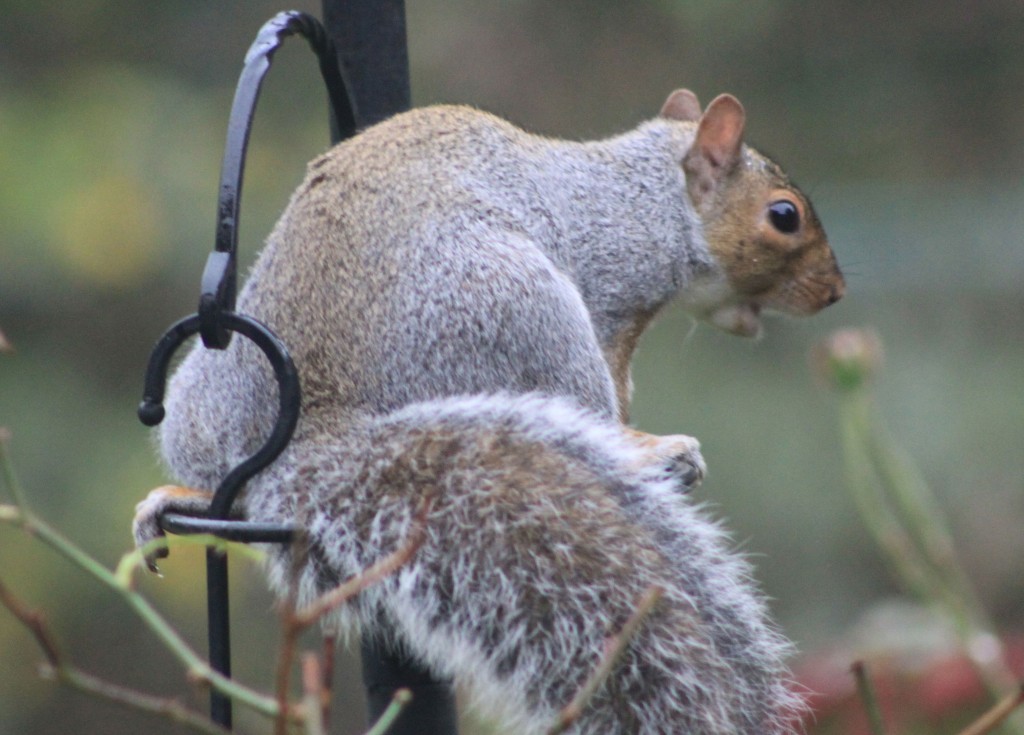
Friendly nature story in Spanish using verbs in the 3rd person present tense about a squirrel trying to steal from a bird feeder that is guarded by a little dog. The story emphasises the value of listening and encourages an interest in nature.
Story, subtitled Videos, Downloadable Worksheets: Gap-Fill Worksheet , Story Transcript in Spanish
+ online Quiz:
Adverbs describe Verbs
Look out for these adverbs in the story: How does a squirrel arrive? silenciosamente = silently!
How hard do the dogs work? muy duro = very hard!
Ella va delante
– She goes in front.
Billy va detrás.
– Billy goes behind.
Listen to birdsong. Listen to the world around you. Have you ever heard a cuckoo, or a woodpecker tapping its head against the trunk of a tree? It is so loud!
Video
Audio in Spanish AND English:
Video Transcript
Es el jardín.
Hay un comedero de pájaros.
¡Mira! ¡Escucha!
Maggie es la guardiana del comedero.
Maggie vigila el jardín.
¡Las ardillas no tienen permiso!
¿Eso qué es?
Una ardilla llega silenciosamente.
Espera. Escucha.
¿Está Maggie en casa?
Empieza a comer las semillas.
¡Ay no! Puede oír algo.
Maggie y Billy han visto la ardilla.
Corren a toda velocidad.
Maggie sabe lo que hay que hacer.
Ella va delante.
Billy va detrás.
Persiguen la ardilla.
¡Muy bien Maggie! ¡Muy bien Billy!
¡Trabajan muy duro!
¡Gracias a Maggie y Billy el comedero de los pájaros está muy bien protegido!
¡Bien hecho Billy! ¡Bien hecho Maggie!
Voici le jardin.
Il y a une mangeoire. Regardez! Écoutez!
Maggie est la gardienne de la mangeoire!
Toute la journée elle surveille le jardin.
Les écureuils sont interdits!
Qu’est-ce que c’est?
Un écureuil arrive doucement.
Il attend. Il écoute.
Est-ce que Maggie est là?
Il commence à manger les graines.
Oh non! Il entend quelque chose.
Maggie et Billy ont vu l’écureuil! (= have seen)
Ils courent à toute vitesse!
Maggie sait ce qu’il faut faire.
Elle va devant!
Billy suit Maggie. Il va derrière.
Ils courent après l’écureuil!
Bravo Maggie! Bravo Billy!
Vous travaillez dur.
Grâce à Maggie et Billy la mangeoire des oiseaux est protégée.
Bien fait Billy! Bien fait Maggie!
The video introduces the characters using the verb SER, and then they say what they are doing using Estar + the Present Continuous:
Use the stem of regular infinitive verbs and add the following to form the present continuous:
AR Verbs:
Trabaj-AR = Trabaj-ando
ER Verbs:
Hac-ER = Hac-iendo
IR Verbs:
Escrib-IR = Escrib-iendo
E.g.
the present participle of ‘trabajar’ (to work) is:
trabajando Estoy trabajando = I am working Estamos trabajando = We are working
¿Qué estás haciendo? What are you doing? Estoy trabajando = I am working Estoy haciendo mis deberes = I am doing my homework Estoy escribiendo en Español = I am writing in Spanish
– – – –
Some irregular verbs are called ‘stem-changing verbs’. Dormir (to sleep) is an example of a ‘stem-changing verb’:
Estoy durmiendo = I am sleeping.
– – – –
Estoy comiendo = I am eating Estás nadando = you are swimming Está durmiendo = he is sleeping Estamos saltando = we are jumping Estáis remando = you (plural) are rowing Están descansando = they are resting
This quiz is also available on its own separate page here: Online Quiz
Un trabalenguas = a tongue twister El Perro de San Roque is a very useful tongue twister for learning how to pronounce Spanish R sounds. Listen and join in with the video and audio recording below
The Words: “El Perro de San Roque no tiene rabo porque Ramón Ramírez se lo ha robabo.”
Translation:
“Saint Roque’s dog doesn’t have a tail because Ramón Ramírez has stolen it.”
To make an ‘R’ sound in Spanish, the tongue needs to be touching the roof of the mouth just behind the bone that holds the top front teeth . The Spanish R sound should be longer for double Rs, and shorter for single Rs.
Spanish ‘Rs’ are different from English ‘Rs’.
(They are not like French ones either, which come from the throat as if you are gargling).
Video
Audio
The words:
‘El perro de San Roque no tiene rabo porque Ramón Ramírez se lo ha robado’
Translation:
San Roque’s dog doesn’t have a tail because Ramón Ramírez has stolen it.
Sport in French Vocabulary + Questions.
Video clip, Online Quiz + Worksheet.
Tu aimes la natation?
Do you like swimming?
Oui, j’aime la natation.
Yes, I like swimming.
Non, je n’aime pas la natation.
No, I don’t like swimming.
Je préfère le rugby.
I prefer rugby.
Vocabulary
Le golf(m) golf La natation(f) swimming Le tennis(m) tennis Le rugby(m) rugby Le cyclisme(m) cycling Le football(m) football Le canoe(m) canoeing La voile(f) sailing Le patinage sur glace(m) ice-skating Le surf(m) surfing Le ski(m) skiing L’équitation(f) horse-riding Monter à cheval horse-riding
Questions and Answers:
Tu aimes le sport? Do you like sport? Oui, j’aime le sport Non, je n’aime pas le sport.
Qu’est-ce que tu aimes? What do you like? J’aime le rugby. Je n’aime pas le golf
Qu’est-ce que tu aimes faire? What do you like doing? J’aime faire de la natation. Je n‘aime pas faire du golf
Qu’est-ce que tu préfères? What do you prefer? Je préfère le tennis.
Videos
Sport in French AND English Video clip:
Online Quiz
This quiz is also available on its own separate page here: Online Quiz
Le Sport:
Ce sont les jeux olympiques 2012.
Tout le monde attend les coureurs.
Les photographes arrivent les premiers.
Et voilà le champion qui arrive!
Le marathon est tellement dur!
Tu aimes le sport? Qu’est-ce que tu aimes faire? Qu’est-ce que tu préfères? Tu aimes le golf?
Oui, j’aime le golf.
Non, je n’aime pas le golf.
Tu aimes le tennis?
Billy aime les balles de tennis!
Tu aimes la natation?
Oui, j’aime la natation.
Non, je n’aime pas la natation.
Tu aimes le rugby?
Billy aime la balle, bien sûr.
Tu aimes le cyclisme?
Oui, j’aime le cyclisme.
Non, je n’aime pas le cyclisme.
Oh, c’est presque toute une famille!
Et bien sûr on joue au football partout dans le monde.
Qu’est-ce que tu préfères?
Moi, je préfère le tennis, et toi?
Tu préfères le canoë? Tu préfères la voile? Ou le patinage sur glace? Le surf? Le ski? Ou monter à cheval? Le Sport:
Il y a quelque chose pour tout le monde!
– – – – –
More: Il y a beaucoup de sports différents
There are lots of different sports On joue au football partout dans le monde!
Football is played everywhere in the world Il y a beaucoup de choses à faire!
There are lots of things to do!
Visit Sport in French – Jouer vs Faire for practice talking about playing ball sports versus doing things like swimming, cycling, rowing …
Go to Hobbies in French: Sport + Music to learn how to talk about playing a sport (e.g football) versus playing a musical instrument.
Soy is the 1st person of SER.
Estoy is the 1st person of ESTAR.
SER + ESTAR both mean TO BE in Spanish, but they are not interchangeable:
Use SER for Who/What
Use the Verb SER to say who or what you are: Soy = 1st person of SER Soy – I am Soy Billy – I am Billy Soy un cachorro – I am a puppy
Use ESTAR for Where
Use the verb ESTAR to say where you are: Estoy = 1st person of ESTAR Estoy I am Estoy en una caja I am in a box
Think of WHAT nationality you are versus WHERE you are, e.g. which country you are in.
Use SOY + Nationality
Soy inglés (inglesa)
– I am English
Soy español (española)
– I am Spanish
Soy argentino (argentina)
– I am Argentine, Argentinian
Soy americano (americana)
– I am American
Use ESTOY for Where you are
Estoy en España – I am in Spain Estoy en los Estados Unidos – I am in the US Estoy en Inglaterra – I am in England Estoy en Argentina – I am in Argentina
– – –
Listen and join in with the friendly characters in the video as they say who or what they are followed by where they are.
Eg: Soy una niña = I am a girl Estoy en la casa = I am in the house
Online Quiz
This quiz is also available on its own separate page here: Quiz Test
Grammar Note: “Les chiens me suivent avec leurs yeux.”
‘Me‘ is a direct object pronoun:
Notice how pronouns go in front of the verb in French, but they go after the verb in English.
‘Leurs‘ is a possessive adjective. ‘LeurS‘ describes the word ‘yeux’ (eyes) and is plural because ‘yeux’ is in the plural, and adjectives need to agree with what they describe.
– – – –
Do people ever follow you with their eyes?
a) Choose one of these: une glace= an ice-cream un packet de chips= a packet of crisps une barre de chocolat= a bar of chocolat
b) Choose two friends.
c) Now say what you have and that those friends are following you with their eyes!
e.g: J’ai une pizza. = I have a pizza
Paul et Marie-Alixmesuivent avec leurs yeux!
(Paul and Marie-Alix follow me with their eyes!)
Suivre = to follow Present tense:
(Note: ‘je suis’ also means ‘I am’!)
Learn the different names for harvest in French: La Récolte – for harvesting fruit La Moisson – for harvesting corn La Vendange – for harvesting grapes
La Rentrée– the first day of the new school year
Short French sentences in the 3rd person present tense describe the weather and activities during early Autumn in French.
French Video Clip, Vocabulary + Worksheet for reading and translation practice and an Online Quiz.
Vocabulary
: les tournesols(m) sunflowers
les mûres(f) blackberries (fruit) les champignons(m) mushrooms les marrons(m) chestnuts / conkers le maïs corn le beurre butter l’école(f) school la rentrée the beginning of the school year
Verbs + Weather terms:
J’adore I love C’est it is Il fait chaud it is hot il fait froid it is cold il pleut it rains il y a there is/there are on voit one sees/ one can see on dit one says il s’agit de … it is about/ to do with
Quel temps fait-il? What is the weather like?
– It’s the start of the new school year. As it is time to get that pencil case ready, here is the vocabulary + practice: LA RENTRÉE
(Translate it into English and check it against the video clip)
Le mois de septembre
C’est le mois de septembre.
Il y a des tournesols.
Regardez le maïs. J’aime bien avec du beurre et un petit peu de sel!
J’adore le maïs!
C’est la rentrée des classes.
Déjà les marronniers changent de couleur.
Les enfants aiment les marrons!
Quel temps fait-il?
Souvent il fait chaud.
Quelquefois il fait froid.
De temps en temps il pleut.
Ceci est un blackberry…
Ceci aussi, mais en français on dit ‘mûre’!
Il y a encore des mûres.
Dépêchez-vous! Elles sont bonnes.
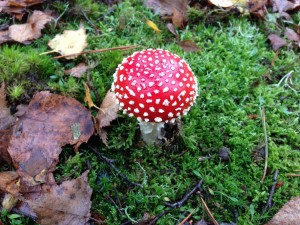
On voit toujours des champignons au mois de septembre.
Attention! Sont-ils vénéneux?
On dit ‘la récolte’ quand il s’agit de fruit.
On dit ‘la moisson’ quand il s’agit de maïs.
On dit ‘la vendange’ quand il s’agit de raisins.
Oh là là! Les tomates ne sont pas mûres!
Alors, c’était bien l`école?
EXERCISE:
1. What do the following mean? – Souvent – Quelquefois – De temps en temps
2. Translate the following into French:
It is often hot
It rains sometimes
Sometimes it’s cold
3. What are the three different names for Harvest in French? Write them down in French. Then write what they mean in English:
a) …
b) …
c) …
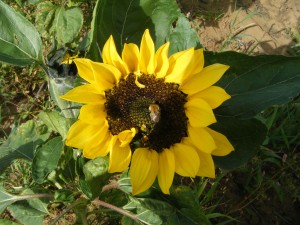
August/September, the season for sunflowers!
Think of Mediterranean countryside with its fields and fields of sunflowers all appearing to turn their heads to the sun as it moves across the sky:
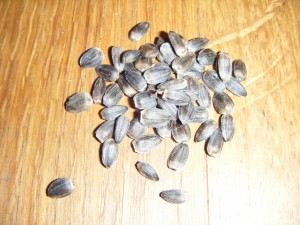
It is also the time for going back to school, and sunflower seeds have long been a healthy and very popular snack for children in Spanish playgrounds and beyond.
They are called Pipas.
Small bags of salted sunflower seeds (Pipas) are a traditional sight in school playgrounds, where they are allowed:
A very messy business because each ‘pipa’ has to be cracked open to reach the sunflower heart inside, usually done using the front teeth, and then there’s the problem of what to do with the discarded shells ….
Piles of slightly damp ‘pipa’ shells ..?!
A little too salty and messy, but otherwise a great idea … And today ‘pipas’ are also sold without their shells!
Free listening practice in French and Spanish: A Green Mouse
A Green Mouse French and Spanish Listening Resources