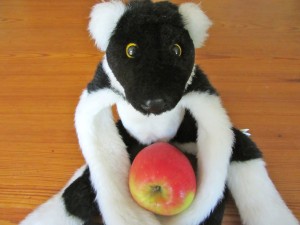
Easy French children’s song + counting rhyme: Lyrics + Video to sing along to and join in with, the actions demonstrated by a friendly lemur.
Join in with the lemur on the video clip.
The words and English translation are printed below the video.
Video
Actions:
Repeat the verse over and over, bashing fists together, alternating the one on top in time to the rhythm of the words.
Verse: Pomme de Reinette, Pomme d’Api, Tapis, tapis rouge. Pomme de Reinette, Pomme d’Api, Tapis, tapis gris!
End: Cache ton poing derrière ton dos!
Hide your fist behind your back! Sinon t’auras un coup de marteau!
Or it will be hit by a hammer!
Pomme de Reinette = Pippin Apple Pomme d’Api = Lady Apple
Plus que = more than. Moins que = less than.
E.g: Je mange moins que mon père
= I eat less than my father
Je joue plus que mon frère
= I play more than my brother
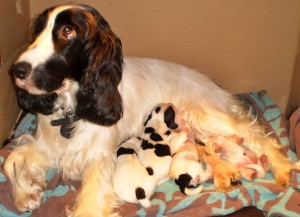
Short Story, Video, Online Quiz + Worksheet which compares two dogs of different ages:
Video
Comparisons + Adjectives:
Adjectives still need to agree with the word they are describing.
Eg: Il est plus âgéque moi = He is older than me
Elle est plus âgéeque moi
= She is older than me
Il est plus grand que moi
= He is bigger than me
Elle est plus grandeque moi
= She is bigger than moi
Ils sont plus grands que moi
= They are bigger than me
Elles sont plus âgéesque moi
= They are older than me
– – – –
Comparisons + Adverbs:
E.g: vite = fast
Il court plus vite que moi
He runs faster than me
– – – – ‘The most’ in French = le plus(m) la plus(f) les plus (m+f plural) – – – –
Video Transcript
Je suis vieux.
Je suis plus âgé que Félix.
Félix est jeune.
Il est plus jeune que moi.
Il court plus vite que moi.
Moi, je ne cours pas du tout.
Je renifle!
J’ai seize ans. Je suis vieux.
C’est beaucoup seize ans?
Pour un chien OUI!
Un an humain égale sept ans pour un chien.
Seize multiplié par sept égale cent douze.
J’ai cent douze ans! Je suis plus âgé que toi!
Connaissez-vous un chien?
Quel âge a-t-il?
Qui est le plus âgé? Toi ou le chien? (= the most)
Maggie(f) est plus âgée que Billy.
Ah, voilà Billy!
Tu es plus jeune que ta maman!
– – – –
Now think about YOURSELF:
a) Who are you older than?
(Add an ‘e‘ to âgé to make âgéeif you are agirl)
Choose a pet, friend, relative, anybody: Je suis plus âgé/âgée que …
b) Who are you younger than? Je suis plus jeune que …
Online Quiz
This quiz is also available on its own separate page: Online Quiz
KS3/4 French Story about holidays and the environment with video and images of the emergency services putting out a forest fire in a hot Mediterranean country during the summer holiday season:
Subtitled videos, Online Quiz, translation practice + worksheets:
– PDF Worksheet – English Translation Practice
Vocabulary:
la plupart du temps most of the time tout à coup suddenly à cause de because of au-dessus overhead, above l’un après l’autre one after the other quelque part somewhere partout everywhere
les feux de forêt forest fires l’incendie the fire la foudre lightening la négligence humaine human negligence les cigales the cicadas un canadair a fire-fighting plane vos déchets your rubbish un hélicoptère bombardier
a fire-fighting helicopter
Faites attention à vos déchets!
Watch out with your rubbish!
Videos
1. French Audio with French and English subtitles:
Short story and video in Spanish for practice learning names of family members. This simple Spanish listening resource is mainly for listening and comprehension practice and includes a worksheet and online quiz.
Video
Spanish + English Subtitles:
Vocabulary
Una familia = a family Tengo una familia = I have a family Tengo hijos. = I have children
Soy una mamá = I am a mother Mis hijos = my children un hijo = a son una hija = a daughter mi hijo mayor = my eldest child mi hijo menor = my youngest child
un niño = a boy una niña = a girl
Mis hermanos = my brothers and sisters un hermano = a brother una hermana = a sister
Los abuelos = the grandparents un abuelo = a grandfather una abuela = a grandmother
Los tíos = the uncles and aunts un tío = an uncle una tía = an aunt
¡Hola! Me llamo Maggie.
Soy una esposa
Mi marido se llama Riddick.
Soy una mamá.
Tengo una familia.
Es mi hijo mayor.
¡Es una niña!
¡Tengo mucho trabajo!
¡Mis hijos!
Las tres hermanas se van.
Su hermano se queda en casa.
Le gustan los abrazos.
¡Le encantan los abrazos!
Me da besos.
Me gusta vivir con mi hijo.
Se llama Billy.
La hermana menor de Billy viene de visita.
Regresa a casa.
¡Le gusta la cama de su hermano!
¡No pasa nada porque su hermano es simpático!
¡Los abuelos!
Este es el abuelo de Billy.
Esta es su abuela.
¡Aquí está su abuela,
y su madre con sus hermanos!
Billy tiene cinco tíos y tres tías.
¡Mi familia!
Online Quiz
This quiz is also available on its own separate page: Online Quiz
Ma famille (f)= My family
Friendly short story and videos in French with images and short sentences in the 1st person + 3rd person followed by an online quiz + worksheet.
Meet Maggie’s family in French!
Video Clips
Version Two with NO English subtitles:
Fill in the gaps on this worksheet to complete the story/video transcript:
Gentle French song for children Traditional French nursery rhyme about a windmill with simple actions and repetitive practice to join in with.
Song lyrics, English translation + video clip:
Video
Can you hear snoring in the background? It’s the miller! He needs to wake up and look after his windmill! If it goes too fast sparks will fly and the windmill could catch fire – watch out!!
The Actions:
Roll your arms and hands over and over each other staying in time with the music.
The music starts slowly and then speeds up when the windmill is going too fast! Meunier, tu dors: Meunier, tu dors!
Miller you are sleeping!
Ton moulin, ton moulin
Your windmill, your windmill
va trop vite!
is going too fast!
Meunier, tu dors!
Miller you are sleeping!
Ton moulin, ton moulin
Your windmill, your windmill
va trop fort.
is going too powerfully
Refrain: Repeat x 2 Ton moulin, ton moulin
Your windmill, your windmill
va trop vite!
is going too fast!
Ton moulin, ton moulin
Your windmill, your windmill
Meet the characters in the video clip, all in different moods, some enthusiastic, others fed up, friendly or self-important.
It makes a difference how you speak to people, not just what you say.
(How about a role play in which children could act out the different scenarios).
Vocabulary:
¡Hola! Hello! ¿Qué tal? How are you? ¿Cómo estás? How are you? Bien gracias Fine thank you. Encantado(a) Delighted to meet you Le presento a … Let me introduce you to … Buenos días Good morning Buenas noches Good night Buenas tardes Good afternoon Hasta luego See you later Hasta pronto See you soon ¡Adiós! Goodbye!
Video Transcript:
¡Hola!
Buenos Días.
¿Qué tal?
Aquí estoy …
¿Y tú? ¿Cómo estás?
Bien gracias. Le presento a mi hermana.
¡Encantado!
¡Encantada! Le presento a …
¡Buenos días Señora Gata!
Buenos días perros. ¿Cómo están?
¡Muy bien gracias! ¿Y usted?
¡Adiós! Hasta luego …
¡Buenos días Felix! ¿Cómo estás?
¡Hola Oscar! Estoy bien gracias. Hasta luego.
¡Hasta luego Oscar!
¡Adiós! ¡Hasta luego! Se llama …
¡Hola! ¿Qué tal?
Le presento a mi amigo.
¡Se llama Billy!
¡Hola! ¡Le presento a mi amigo!
¡Se llama Agustín!
¡Hasta pronto! (x4!)
¡Buenas noches!
¡Buenas noches Billy!
¡Buenas noches a todos!
Rusty French? Lacking in confidence? These workshops might help …
A Green Mouse has been asked to pass on the following information from the Alliance française:
“In partnership with the French Institute in London, the Alliance française de Manchester is organising a series of 6 workshops to support any practitioners involved in teaching French in Key Stage 2, especially class teachers and teaching assistants, who would like to get started with French or to use it more regularly in the classroom, from 14th January 2014 onwards.
These workshops are aimed at practitioners who have little or no knowledge of French, including those who feel rusty and lack the confidence to use their French in the classroom and will be led by Catherine Cheater, renowned trainer both nationally and internationally, and author of Catherine Cheater Schemes of Work for French.
With a maximum of 20 participants, these sessions of 3 hours each aim to be friendly, supportive and fun. As such, participants need not feel anxious about their level of French. Handouts with key language will be provided at each session.
For further information on dates and times, please refer to the following link on our website: KS2 French Workshops ”
Un mono, un oso, un plátano
Un mono, dos frambuesas
– una, dos
¡Uy! ¿Dónde está su cabeza?
Un mono, tres arándanos
– uno, dos tres
Un mono, cuatro melocotones
– uno, dos, tres, cuatro
Un mono, cinco albaricoques
– uno, dos, tres, cuatro, cinco
Un mono, seis nectarinas
– una, dos, tres, cuatro, cinco, seis
Un mono, siete manzanas
– una, dos, tres, cuatro, cinco, seis, siete
Un mono, ocho fresas
– una, dos, tres, cuatro, cinco, seis, siete, ocho
Un mono, nueve pasas
– una, dos, tres, cuatro, cinco, seis, siete, ocho, nueve
Un mono, diez albaricoques
– uno, dos, tres, cuatro, cinco, seis, siete, ocho, nueve, diez
¡Hasta luego!
Count to 10 in Spanish
Click here to sing and count Spanish numbers 0 – 10 in a song.
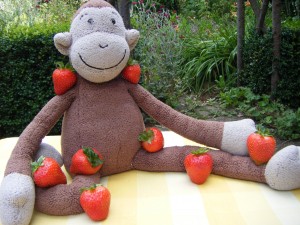
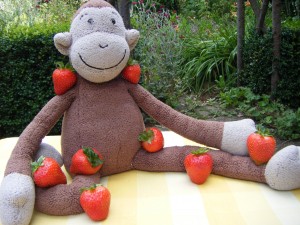
Learn numbers 1 to 10 in French by counting fruit:
Learn the names of fruit in French too, and their genders via the video clip.
The fruit is placed in fun places for children to spot while they count along in French with the video:
un 1 deux 2 trois 3 quatre 4 cinq 5 six 6 sept 7 huit 8 neuf 9 dix 10
‘Un’ (1) also means ‘a‘ or ‘an‘
Words in French are masculine or feminine, even fruit! Un changes to Une with feminine words
Eg: un abricot(m)an apricot un singe(m)a monkey une fraise(f)a strawberry
Fruit Vocabulary
a Banana une banane(f)
a raspberry une framboise(f)
a blueberry une myrtille(f)
a peach une pêche(f)
an apricot un abricot(m)
a nectarine une nectarine(f)
an apple une pomme(f)
a strawberry une fraise(f) a raisin un raisin sec(m)
Un singe, un ours(m), une banane(f)
Un singe, deux framboises
Oh non! Où est sa tête?
Un singe, trois myrtilles
Un singe, quatre pêches
Un singe, cinq abricots
Un singe, six nectarines
Un singe, sept pommes
Un singe, huit fraises
Un singe, neuf raisins secs
Un singe, un ours, dix abricots
Meeting and Greeting in French
– Vocabulary + Video:
Whatever language is used, just a few short words can be welcoming and make people feel great, or have a very different effect.
Video
Vocabulary
Bonjour Hello, Hi Bonsoir Good Evening Bonne nuit Good night Comment vas-tu? How are you? Comment allez-vous?
How are you? (Plural + formal greeting)
Ça va?
How ‘s it going? How are you? Comment ça va?
How are you getting on? How are you?
Ça va Fine … I’m fine Très bien merci Very well thank you
Au revoir Goodbye
À plus tard See you later
À bientôt See you soon
Je m’appelle My name is (I call myself) Il s’appelle His name is (He calls himself)
Je vous présente mon ami …
= Let me introduce you to my friend …
Bonsoir (Good Evening) is not included in this resource. How about coming up with a good idea for presenting that …?!
The tone used when you meet somebody says so much about you. A few short words can express so much emotion, friendly vibes, an air of superiority, respect …
This subtitled French video clip introduces a variety of characters, all in different moods, some enthusiastic, others fed up or just relaxed and friendly.
Video Transcript in French
Salut!
Bonjour. Comment vas-tu?
Oh, ça va. Et toi? Ça va?
Ça va merci. Je vous présente ma soeur.
Enchanté. Je vous présente …
Oh! Bonjour Madame la Chatte!
Bonjour les chiens. Comment allez-vous?
Très bien merci! Et vous?
Au revoir. À plus tard …
Bonjour Félix! Ça va?
Bonjour Oscar! Oui, ça va. À plus tard.
À plus tard Oscar …
Au revoir! À plus tard … Il s’appelle …
Salut! Comment ça va?
Je vous présente mon ami.
Il s’appelle Billy.
Salut! Je vous présente mon ami!
Il s’appelle Auguste.
À bientôt!
À bientôt!
À bientôt!
À bientôt!
Bonne nuit!
Bonne nuit Billy.
Bonne nuit tout le monde!
Introductions in French
For an introduction to members of the family click here: Ma Famille!
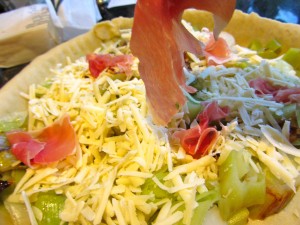
Tarte aux Poireaux:
Delicious recipe for a French leek tart adapted to the UK by using mature cheddar cheese.
(Gruyère cheese is more authentic but cheddar works very well).
Video Clip with French/English subtitles.
Vocabulary:
Ingrédients ingredients Préparation cooking instructions Un moule mould or tin La pâte brisée shortcrust pastry Une cuillerée a teaspoon Un rouleau a rolling pin Le fond the base
Verbs:
Préchauffez Pre-heat Mélangez Mix Étendez Roll out Coupez Cut Ajoutez Add Assaisonez Season Chauffez Heat Versez Pour
Ingredients:
shortcrust pastry
(100g plain flour, 60g butter, 1tspn French mustard, cold water to bind pastry together)
1kg leeks
50g watercress
7 eggs
100g serrano or parma ham
200g grated mature cheddar cheese.
28cm tart tin
Strong tip: Make the pastry base as thin as possible and cook the pastry base blind before adding the rest of the ingredients.
Recipe Video
Subtitles in French and English
The Recipe in French
PRÉPARATION: Préchauffez le four à 210C Prenez un moule à tarte anti-adhésif de 28cms. Faites une pâte brisée avec 100g de farine, 60g de beurre, une cuillerée de moutarde et de l’eau froide. Étendez la pâte au rouleau. Piquez le fond avec une fourchette.
Maintenant il faut préparer un kilo de poireaux. Retirez les feuilles vertes. Coupez le bout de chaque poireau. Lavez bien les poireaux.
Ensuite mettez 25g de beurre dans une casserole,
et chauffez les poireaux. Faites cuire pendant 10minutes. Faites écouler l’eau avant de répartir les poireaux sur le fond de pâte crue. Ajoutez 50g de cresson,
100g de vieux cheddar râpé,
et 50g de jambon. Mélangez sept oeufs dans un bol. Assaisonez. Versez les oeufs sur la tarte. Ajoutez encore 100g de vieux cheddar râpé, 50g de jambon, et du poivre.
Temps de cuisson: Environ 30 minutes
Une belle tarte aux poireaux!
– – – Challenge:
Translate the verbs in the recipe instructions (highlighted in bold) into English.
Simple questions have been added to the video clip of a short story in French about two dogs on a walk by the river.
For worksheets of the story, a video with no English subtitles, and an online quiz go to: Dogs at the river in French
Que fait-il?
What is he doing?
Qu’est-ce qu’il a?
What has he got?
Où est Maggie?
Where is Maggie?
Questions
In English:
1. What is Billy doing in the river?
2. What does Billy have in his mouth?
3. Does Maggie like swimming?
4. What does Maggie do?
5. How does Billy arrive?
In French: 1. Que fait Billy dans la rivière? … 2. Qu’est-ce que Billy a dans sa bouche? … 3. Est-ce que Maggie aime nager? … 4. Que fait Maggie? … 5. Comment arrive Billy? (Comment = How) …
Learn the vocabulary for items in a pencil case and their gender: Short sentences in Spanish introduce pencil case items using the 1st person of the verb Tener: Tengo = I have Tengo un lápiz (m) = I have a pencil Tengo una goma (f) = I have a rubber
Listen and join in with the video clip. Learn the vocabulary and then do the online quiz,
Vocabulary
un estuche(m) a pencil case un bolígrafo (m) a biro un lápiz (m) a pencil un sacapuntas (m) a pencil sharpener un cuaderno (m) a notepad un cartucho (m) a cartridge un libro (m) a book
una regla (f) a ruler una goma (f) a rubber una pluma (f) a pen
una papelera (f)
a wastepaper bin
los lápices de colores (m)
the coloured pencils
el papel (m)the paper
la cola (f) the glue las tijeras (f) the scissors
la basura (f) the rubbish
Video
Online Quiz
This quiz is also available on its own separate page here: online quiz
¡Tengo! Tengo una mochila
La mochila(f) the rucksack Tengo un estuche
El estuche(m) the pencil case
¿Qué tengo en mi estuche? What do I have in my pencil case? Tengo una pluma
La pluma(f) the pen Tengo un lápiz
El lápiz(m) the pencil Tengo una goma
La goma(f) the rubber Tengo un cuaderno
El cuaderno(m) the exercise book Tengo un libro
El libro(m) the book Tengo papel
El papel(m) the paper Tengo tijeras
Las tijeras(fpl) the scissors Tengo una regla
La regla(f) the ruler Tengo cartuchos
Los cartuchos(mpl) the cartridges Tengo un bolígrafo
El bolígrafo(m) the biro Tengo cola
La cola(f) the glue Tengo lápices de colores
Los lápices de colores(mpl) the coloured pencils Tengo un sacapuntas
El sacapuntas(m) the pencil sharpener
¿Y ahora qué? Pongo la basura aquí.
I put the rubbish here. Tengo una pregunta para Billy. I have a question for Billy
¿Tienes vergüenza? Are you ashamed? ¡Sí, tengo vergüenza!
Yes, I am ashamed!
Homophones are words that sound the same but mean different things. Ces, Ses, C’est are common French homophones which can easily be mixed up.
French Grammar + Practice via a friendly Nature story, Video, Online Quiz + Worksheet
Tip:
A useful way to avoid writing C’est in the wrong place is to ask yourself whether ‘it is’ fits in and makes sense with the rest of the sentence.
Ces
CES = These/those: Ces is a demonstrative adjective used to describe a plural noun.
E.g. What sort of apples?
These apples – Ces pommes
Those apples – Ces pommes
Ses
Ses is a Possessive Adjective Ses = His/Her/Its + a plural noun.
(Like all French adjectives, possessive adjectives agree with the noun they refer to).
E.g: Whose/What sort of parents?
Her parents – Ses parents
Whose/What sort of cousins?
His cousins – Ses cousins
C’est
C’est comes from Ce + est Ce is a demonstrative adjective C’est = It is, this is, that is C’est = Ce + est
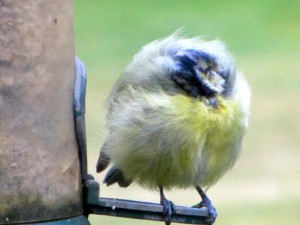
Eg: C’est un petit oiseau – It is a little bird
– – –
DEMONSTRATIVE ADJECTIVES: Ce = This/That + masculine noun Cet = This/That + masculine noun beginning with a vowel Cette (f) = This/That + feminine noun Ces = These/Those + all plural nouns
Video
Online Quiz
This quiz is also available on its own page: Online Quiz
C’est un jour important!
Ces parents s’inquiètent!
C’est la maman.
Cette maman s’inquiète …
C’est le papa!
Ce papa s’inquiète … Qu’est-ce qui se passe?
Leur oisillon apprend à voler. (Leur = Their)
Qu’est-ce que c’est?
C’est leur petit!
Il ne bouge pas …
Ses parents s’inquiètent!
Cet oiseau est dangereux!
Que fait ce petit?
C’est incroyable ..!
Ce petit dort!
Cet oiseau regarde.
Heureusement le petit se réveille …
Quoi? Qu’est-ce que c’est? Oh! Il faut s’échapper!
Try to picture the idea of having hunger or having years that belong to you …
Why? Because instead of saying ‘I am hungry’ or ‘I am 9’, French people say, ‘I have hunger’ and ‘I have 9 years’:
J’ai – I have Qu’est-ce que tu as?
What have you got? J’ai des bottes(f).
I have some boots. J’ai un chien.
I have a dog. J’ai un cochon d’Inde.
I have a guinea pig. J’ai un cadeau.
I have a present. J’ai des devoirs(m).
I have some homework. J’ai une gomme.
I have a rubber.
Et toi? Qu’est-ce que tu as?
And you? What have you got? J’ai un gâteau.
I have a cake. Et toi? Qu’est-ce que tu as?
And you? What have you got? J’ai un sourire!
I have a smile! J’ai une maman!
I have a mum! Et toi? Qu’est-ce que tu as?
And you? What have you got? J’ai un jouet.
I have a toy.
J’ai mal à la tête!
I have a headache Et toi? Qu’est-ce que tu as?
And you? What’s wrong? (What have you got?) J’ai mal au doigt!
I have a sore finger!
ATTENTION! J’ai faim! I am hungry J’ai soif! I am thirsty J’ai froid! I am cold J’ai chaud! I am hot J’ai sommeil! I am sleepy
AGE IN FRENCH J’ai dix ans. I am ten J’ai deux ans. I am two J’ai cinq ans. I am five J’ai sept ans. I am seven J’ai neuf ans. I am nine J’ai seize ans I am sixteen
Online Quiz
This quiz is also available on its own separate page here: Online Quiz
Easy Re-fried Bean Recipe + Video in Spanish Refried beans are normally cooked slowly for several hours.
This recipe takes a short cut and uses tinned beans which are still delicious.
Ingredients:
1-2 tbsp sunflower oil
2 onions – chopped
4 garlic cloves – crushed
2x 400g cans kidney beans
500g carton of tomato passata
2 tsp cumin
4 tsp paprika
1 red pepper
1 beef stock cube – crumble between fingers
juice of one lemon
Method:
Heat the oil in heavy casserole over direct heat.
Stir fry the onions and garlic until soft.
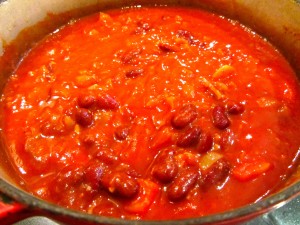
Stir in the kidney beans, chopped red pepper and tomato passata.
Add the cumin, paprika and crumbled stock cube
Stir in the lemon juice
Bring to the boil and then simmer gently on a low heat or place in a pre-heated oven at 170C for 1 hour.
Purée the cooked beans using a handheld blender or a potato masher.
Serve hot sprinkled with grated cheddar cheese, a few chopped coriander leaves, a spoonful of sour cream perhaps, and some tortilla chips. It is also delicious to heat, chop and add a few pieces of chorizo to the dip just before serving.
Suitable for freezing: Store in small freezer bags for use when required.
(For a more traditional version of this recipe, replace the passata, lemon juice and stock cube with water, salt and a few slices of bacon or chorizo)
An essential, protein-rich food in Mexico and Central America, the beans in this recipe can be kept whole and used in Bean quesadillas.
Purée or mash them up, and they become frijoles refritos, an excellent dip, filling for a tortilla, or accompaniment to add Latin American flavour to a meal.
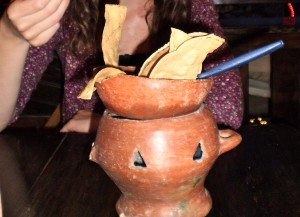
In Honduras frijoles refritos are served in a clay pot called an ANAFRE:
The ANAFRE contains hot coals. The beans are served hot with melted cheese, cream and chopped coriander + tortillas or tortilla chips on the side.
Refried beans are often served with fried eggs, rolled up in a tortilla for a snack lunch, or served as part of a main course with meat, grated cabbage, fried banana, rice, and ‘chismol’ – a ‘salsa’ made of tomatoes, onions and peppers.